






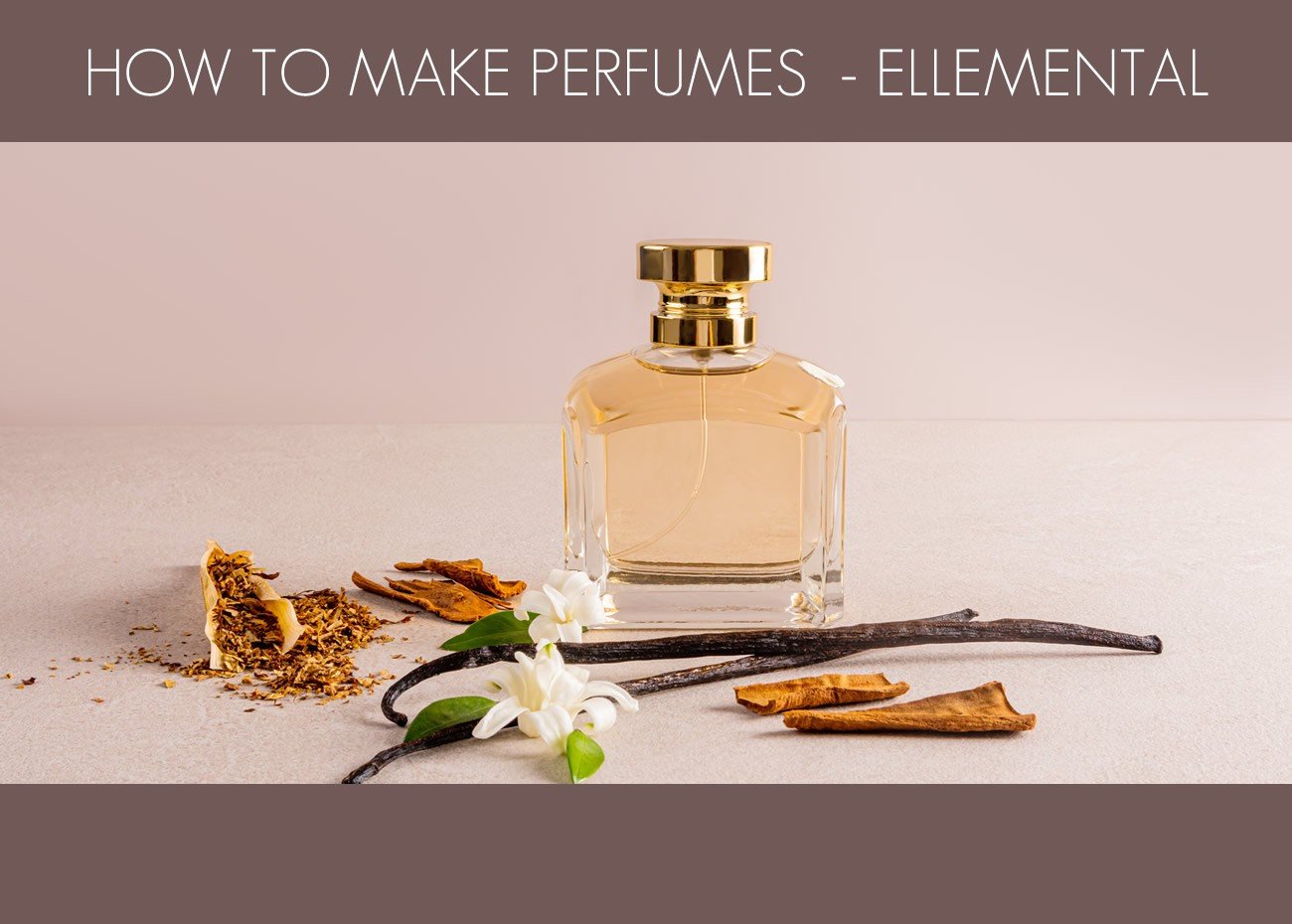
Perfume is a state of mind, an intimate universe, an alchemy of the senses, a connection with the deepest instincts. The olfactory description of a fragrance requires metaphors.
The perfumer's trade was learned in the past after many years of apprenticeship with a master. Even today, this remains the best way to master the secrets of the trade. The composition of a single perfume contains several to hundreds of different substances. The perfumer has thousands of synthetic substances and several hundred natural ingredients at his disposal.
Nowadays natural raw materials are rare and expensive compared to synthesized ones but they are worth more for the harmony of a fragrance, bringing complexity and a lively synergy. Most modern perfumes are blends of natural and synthetic fragrances.
Natural raw materials come from all over the world and can be classified as follows:
- essential oils
- absolute and concrete
- CO2 extract
- resins and conditioners
- tinctures
- isolated fractions of essential oils
Creating a perfume in old school workshops takes from a month to a few years. Guerlain says: "to create a perfume, a good perfume, means having a lot of patience".
An original fragrance can be imitated, but a perfect copy is almost impossible without knowing the original formula and the origin of the ingredients. It can be simulated with five or hundreds of ingredients but a refined nose will distinguish the substitutes.
They are easy to prepare as most essential oils, concrete or absolute oils and tinctures are soluble in alcohol, which is a liquid medium that is rapidly volatile and preserves the composition very well.
Fragrance compositions are divided into categories differentiated by the concentration of fragrance ingredients and their intended use.
| category | concentration | how long the smell lasts |
| PARFUM | 15-35% essences | one or more days |
| EAU DE PARFUM | 10-20% essences | several hours, up to a day |
| EAU DE TOILET | 5-10% essences | 2-3 hours |
| EAU DE COLOGNE | 1-2 hours |
The basis of these perfuming compositions is 90 - 96° alcohol. Pure grain alcohol can be found in grocery stores, but undenatured 70° alcohol is rarely available in pharmacies. For eau de cologne, since fewer essences are used, 60-90° alcohol can be used. To obtain a strength of 60°, mix 100 ml of 96° alcohol plus 53 ml of distilled (floral) water.
Fragrance composition:
- is preferably performed in the morning, when we feel better and the nose is rested. The body and clothes should not be impregnated with any smell (detergent, creams, household odours)
- theoretically formulate the combination of fragrance ingredients taking into account the desired olfactory family and personal preferences; work with a notebook
IN PRACTICE (simple method):
- choose the fragrance ingredients and prepare the samples: put one
drop on a strip of cardboard or a cotton bud. Swab the samples together under the nose to anticipate the smell of the combination. Double or triple those samples whose note you want to be more prominent. Eliminate those samples that do not fit in the combination - the sense of smell tires quickly, so between tests take a short break and smell your own coat, in the fold of the elbow for example
- the most suitable combination is noted after testing the samples. The fragrance will certainly smell more complex and slightly different from the one initially tested once it matures, but this procedure will help to avoid unpleasant combinations
- the percentages of essences and alcohol base shall be determined
- Transfer the calculated quantity of alcohol to a bottle with a cap, over which the chosen fragrance ingredients are added precisely one at a time
- shake the container vigorously
- the composition is allowed to stand for synergisation in
container sealed tightly in a cool place away from light for at least one week (ideally 4 weeks) so that the substances can intertwine. Shake the container daily - Depending on the composition, some waxy elements precipitate or deposit at the base of the container
- filtration must be preceded by decanting, for this the bottle is put in the freezer in the evening until the next morning
- filtration follows (with filter paper or a filter funnel), after which the fragrance is transferred to the dedicated container
IN PRACTICE (classic method):
- the fragrance ingredients are chosen for each chord. Mark 3 bottles each with a label
- work separately for each note. Place one
drop of each essence selected for that note. Sniff, then gradually add onedrop of the various essences until the desired smell is achieved. The procedure also applies to the following notes - the sense of smell tires quickly, so between tests take a short break and smell your own coat, in the fold of the elbow for example
- note the combinations made, for each note which essences and how many
drops were used - the proportion between base and essences is established (e.g. 80% alcohol + 20% essences)
- the final agreement is made in a bottle combining the three component agreements
- Into another bottle transfer the calculated amount of alcohol, over which the content of the final agreement is added. Shake the container vigorously
- the composition is left to rest for synergisation in a sealed bottle in a cool place away from light for at least one week (ideally 4 weeks), so that the elements are intertwined. Shake the container daily
- Depending on the composition some waxy elements precipitate or deposit at the base of the container
- filtration must be preceded by decanting, for this the bottle is put in the freezer in the evening until the next morning
- filtration follows (with filter paper or a filter funnel), after which the fragrance is transferred to the dedicated container
They can be formulated in vegetable oils, for example jojoba oil, or you can choose another oil that is resistant to oxidation and has as neutral an odour as possible. An addition of 0.2-0.5% vitamin E is recommended to protect the composition against rancidity.
The advantage of these compositions is that they are well tolerated by the skin and do not volatilise so quickly, but they cannot be applied to clothes. The disadvantage would be that not all fragrance essences are oil-soluble, so they cannot be used.
In practice, the steps listed above are followed in formulating alcohol-based perfumes. The composition is left to mature for as long as possible. Decanting and filtering is only mandatory in certain cases.
| category | concentration | how long the smell lasts |
| PULS PERFUME | 15-35% essences | one or more days |
| PERFUME OIL | 5-15% essences | a few hours |
They are based on wax (soy wax is generally recommended but beeswax is also good) and vegetable butters/oils. The concentration of fragrance ingredients can be between 5 and 35%.
For the formulation of the essence follow the steps indicated for the preparation of alcohol-based perfumes. The base is prepared by melting on a water bath in a
These are not precise, so some essences may fall sometimes into another category.
| TOP NOTES | MIDDLE NOTES | BASE NOTES |
| Bergamot, Cajeput, Clementine, Eucalyptus, Grapefruit, Lemon, Lime, Litsea, Mandarin orange, Orange, Niaouli, Ravensara, Verbena | Anise, Bay, Cardamom, Jasmine, Carob, Chamomile, Cypress, Fennel, Geranium, Cedarwood, Lemongrass, Magnolia, Green Mandarin, Myrtle, Neroli, Clove, Nutmeg, Oregano, Osmanthus, Palmarosa, Black pepper, Peppermint, Petitgrain, Scots pine, Rosemary, Lavender, Rosewood, Nard, Thyme, Tuberose, Violet, Sage, White rose, Damask rose, Tea tree, Ylang-ylang | Ambrette, Benzoin, Balsam Peru, Cassia, Atlas Cedar, Frangipani, Narcissus, Cinnamon, Incense, Ginger, Guaiac, Labdanum, Patchouli, Vetiver, Sandalwood, Sandalwood Amyris, Myrrh, Tonka, Vanilla |
FIXATORS
These are essences with base notes that also play a role in fixing the aroma: Vetiver, Patchouli, Guaiac, Iris powder, Cedar Atlas
OLFACTIVE FAMILIES
- Floral (lavender, azaleas, roses, jasmine, tuberose, violets, lilac, neroli, magnolia, daffodil). Variants: soliflore, bouquet, green floral, woody floral, fruity floral, green floral. Meaning: romantic, delicate, tender, feminine.
- Amber or oriental (ambrette, frankincense, benzoin, turkey balsam, myrrh, sandalwood, opoponax). Variants: floral amber, sweet amber, citrus amber, woody amber. Meaning: exotic, sensual, warm, deep, voluptuous
- Woody (sandalwood, cedar, vetiver). Variants: coniferous wood, aromatic wood, leather wood, spicy wood, marine wood, fruity wood. Meaning: vigorous, stimulating, attractive
- Citrus (lemon, mandarin, bergamot, petitgrain, orange). Variants: floral citric, spicy citric, woody citric, aromatic citric. Meaning: fresh, light, lively, youthful, tonic
- Cyprus (bergamot, patchouli, labdanum, lichen). Variants: floral chypre, fruity chypre, aldehydic chypre, green chypre, leather chypre. Meaning: sophisticated, distinguished, vibrant, persistent
- Fougère (nard, lichen, coumarin, vetiver). Variant: fougère ambrat, fougère picant, fougère aromat, fougère fructat
- Other families: Gourmet, Aquatic, Tobacco (tonka) or Leather, Aldehyde, Green, Ozone....
Fragrances feel different depending on skin type and chemistry. Tastes and preferences differ so much that any fragrance with wonderful and pleasant scents for some people may cause repulsion in others.
To create your own perfumes you need enough inspiration, a lot of patience and a bit of luck
References and recommendations
La technique moderne les formulules de la parfumerie, Fouquet Henri, Paris, 1951
Les sens du parfum, Robert Guy, Paris, 2000
Perfumes: The Guide, Luca Turin, Tania Sanchez, 2008
Perfumery: practice and principles. Calkin, Robert R. & Jellinek, J. Stephen 1994
Perfume Legends: French Feminine Fragrances, Edwards, Michael 1997
1000 Perfumes, Octavian Sever Coifan, Curtea Veche Publishing House 2003
www.basenotes.net